Bicol history has a funny habit: just when you think a boundary is permanent, the map decides to do a plot twist.
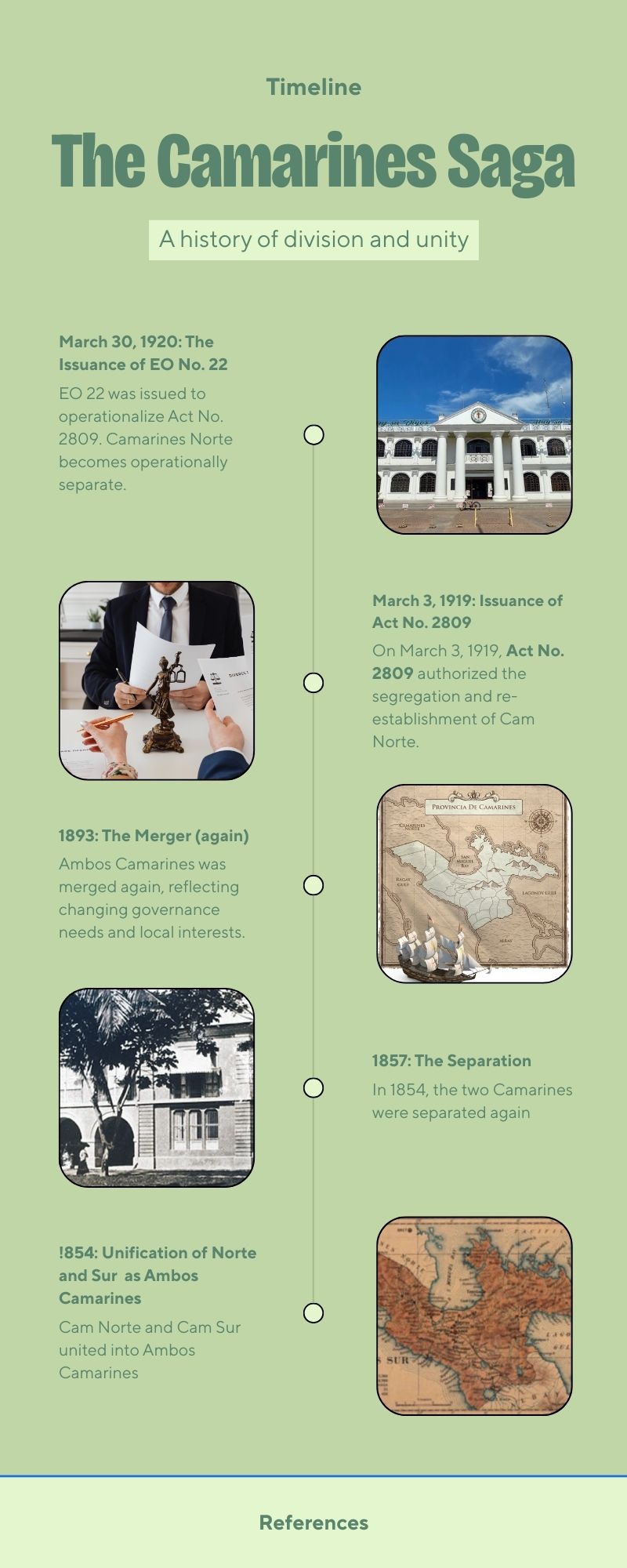
One of the biggest twists happened on March 3, 1919, when the Philippine Legislature passed Act No. 2809—the law that authorized the segregation of Camarines Norte from “Ambos Camarines” and the re-establishment of Camarines Norte as a full-fledged province again.
So yes: Cam Norte didn’t just “separate.” It was re-established—meaning it had an earlier life, got merged, then got its own provincial government back.
What was “Ambos Camarines,” anyway?
“Ambos” is Spanish for “both.” For long stretches of the 1800s and early 1900s, the two Camarines were treated as one administrative unit in different arrangements—merged, separated, merged again—until the American-era reorganization phase.
Think of it like a long-running on-and-off relationship—except the couple is two provinces, and the third party is bureaucracy.
What Act No. 2809 actually did
Act No. 2809 wasn’t just “okay, hiwalay na kayo.” It laid down the practical mechanics of becoming a province again—because a province is not a vibe. It’s an operating system.
1) It restored Cam Norte’s territory and capital
The law states that the re-established Camarines Norte would have the same territory as before the consolidation and that Daet would be its capital.
That matters because “re-establishment” isn’t just a name change—it’s a claim to jurisdiction, records, and administrative continuity.
2) It treated Cam Norte like a regular province
The act made Camarines Norte subject to the general laws on provincial governments—meaning it would have the expected structure and authority of a normal province, not some “special area” stuck in limbo.
3) It reshaped political representation
Act 2809 also addressed representation: Camarines Norte would have its own representation in the legislature, while what remained would be organized accordingly.
That’s not a minor clause. Representation is power: it affects how loudly a province speaks in national decision-making—budgets, public works, education, appointments, you name it.
4) It dealt with the awkward part: money, property, and obligations
Separations are not just about geography—they’re about who gets what, and who pays what.
Act 2809 provided for an equitable distribution of funds, obligations, and property between the provinces, under government oversight. Translation: you don’t just split the map; you also split the assets, liabilities, and administrative baggage.
Because without this, you get the classic post-breakup problem: “Kanino yung records?” “Kanino yung building?” “Sino magbabayad ng utang?”
The plot twist: 1919 was the law—1920 was the switch-on
Here’s a detail people often miss:
- Act No. 2809 was enacted on March 3, 1919 (the legal authority).
- The actual operational separation was implemented when Governor-General Francis Burton Harrison issued Executive Order No. 22 on March 30, 1920, making the re-establishment effective April 15, 1920.
Simply put, and if you want to be precise: 1919 gave the greenlight while April 15, 1920 opened the office doors of the provincial government.
Why it still matters
First, governance got closer to the people (at least in theory). A separate province means separate budgeting, separate priorities, separate accountability. It can mean faster decisions and a government that’s less “far away”—if leadership and systems are competent.
Second, it reshaped political power. Act 2809 wasn’t shy about representation and administrative structure. It shows how political boundaries are also about voice and resource access, not just culture and identity.
Third, the law is a reminder that boundaries are policy choices. Whenever today’s politicians float ideas like “new provinces,” “divide this,” or “create that,” Act 2809 is your historical mirror: splitting a unit is not just a headline. It’s assets, liabilities, staffing, services, records, and representation—with very real consequences for citizens.
References
- Act No. 2809 (1919), as reproduced/archived by the Supreme Court E-Library: An Act authorizing the Governor-General to re-establish the province of Camarines Norte…
(Supreme Court E-Library) https://elibrary.judiciary.gov.ph/thebookshelf/showdocs/28/34350 - Bañas v. Court of Appeals, G.R. No. 80796 (Nov. 9, 1989) (discussion includes the implementation of Act No. 2809 via Executive Order No. 22 and effectivity date April 15, 1920)
(LawPhil) https://lawphil.net/judjuris/juri1989/nov1989/gr_80796_1989.html - Camarines Sur Provincial Government – Brief History (general historical context on the province’s development and administrative history)
https://www.camarinessur.gov.ph/about/province-brief-history






Leave a comment