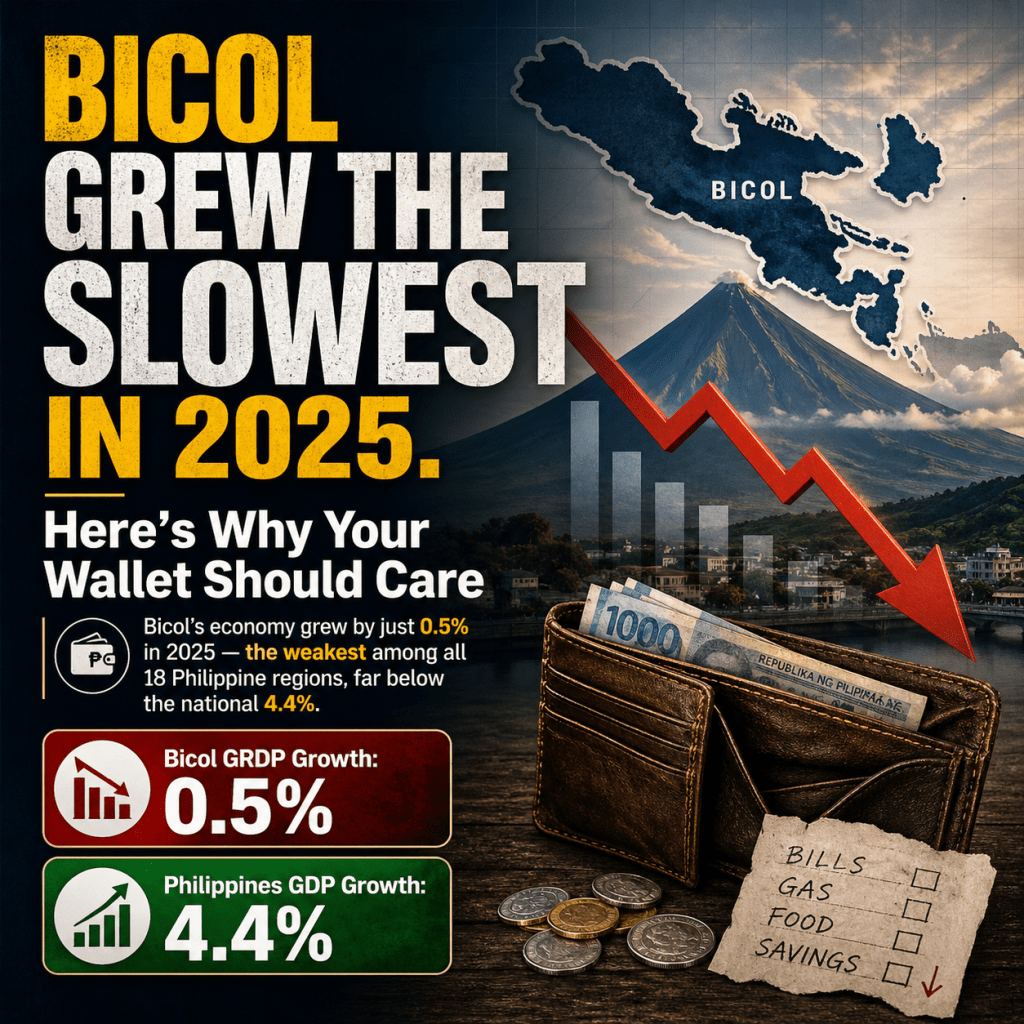
Imagine running a race where everyone else finishes ahead of you. Not just a few people. Everyone. All 17 other regions in the Philippines crossed the finish line before Bicol did in 2025.
That’s essentially what the government is telling us.
According to the Philippine Statistics Authority (PSA), Western Visayas recorded the fastest economic growth among all regions in 2025 at 6.4 percent, with Caraga coming in second at 5.7 percent. Bicol? It came in last — at just 0.5 percent.PSA
And every Bicolano deserves to know about it.
First — What Does “Economic Growth” Even Mean?
Before your eyes glaze over, stick with us.
When we talk about a region’s economic growth, we’re really asking: did people earn more, spend more, and invest more compared to last year? Think of it like a neighborhood. If new shops open, more people get hired, and families have more money to spend — that neighborhood is “growing.” If stores close, jobs disappear, and wallets stay thin — it’s not.
For Bicol in 2025, the economy barely moved.
How Bad Is 0.5%?
Pretty bad — especially when you see it side by side with everyone else.
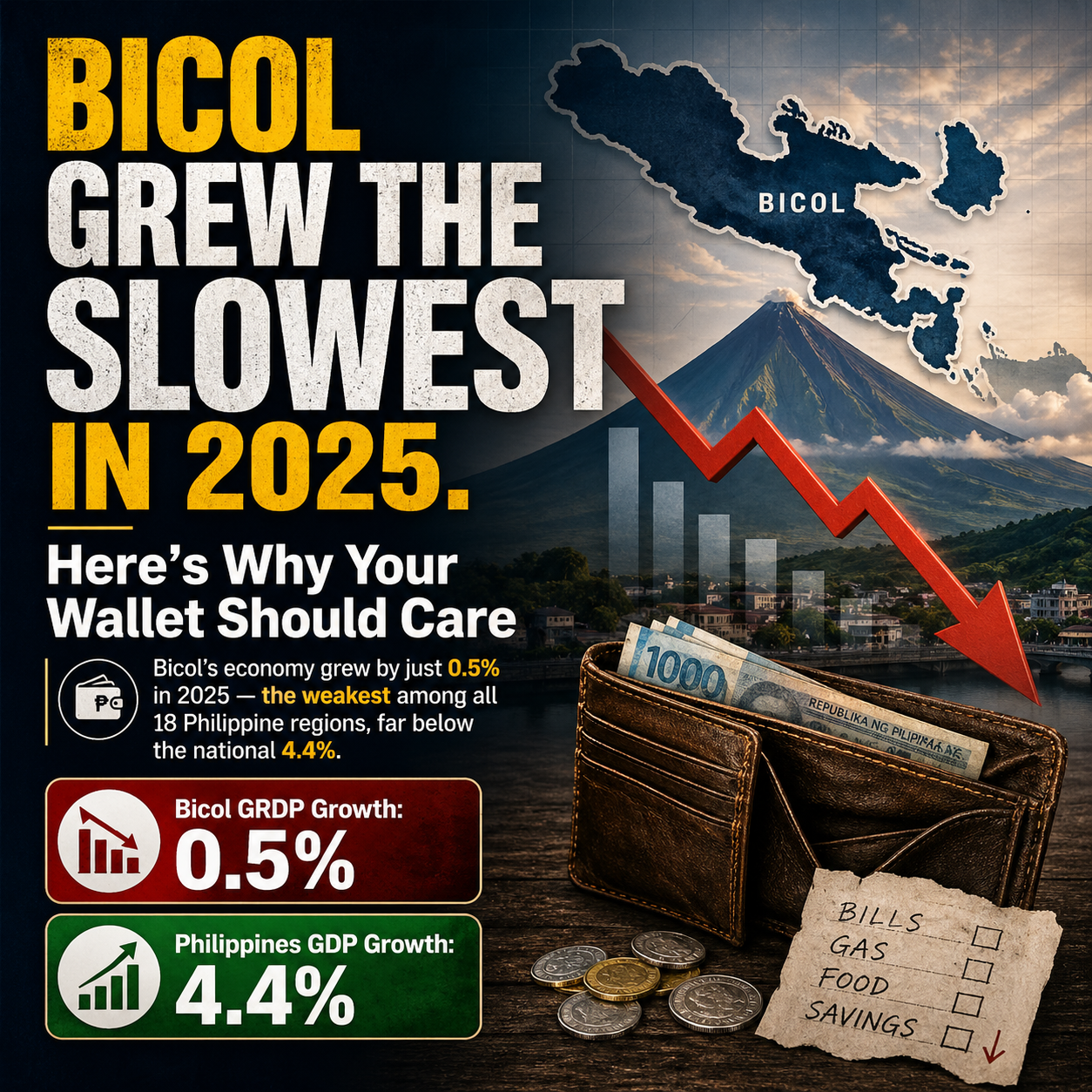
The national GDP grew at 4.4 percent for the full year 2025. Bicol grew at 0.5 percent. That means Bicol’s economy grew nearly nine times slower than the rest of the country. Philippine Statistics Authority
Here’s a quick look at how regions compared:
| Region | 2025 Growth Rate |
|---|---|
| 🥇 Western Visayas | 6.4% |
| 🥈 Caraga | 5.7% |
| 🥉 Negros Island Region | 5.7% |
| 🇵🇭 National Average | 4.4% |
| Eastern Visayas | 1.0% |
| Bicol Region | 0.5% 🔴 Last |
Ten regions grew faster than the national average. Bicol didn’t just miss that mark — it came in dead last among all 18 regions in the country.
The Part That’s Really Worrying: Investments Are Walking Out the Door
Here’s where it gets more serious.
Businesses and government agencies “invest” in a region by building roads, putting up factories, buying equipment, and starting projects. That investment is what creates jobs and makes future growth possible. Think of it as planting seeds for tomorrow’s harvest.
In Bicol, those seeds are not being planted.
In 2025, investment in Bicol dropped by 17.2 percent — the second-largest investment decline in the entire country. Only one other region did worse. At the national level, Caraga posted the strongest investment growth among all regions. Bicol moved in the exact opposite direction. PSA
When investors pull back, it usually means they don’t see enough opportunity, stability, or infrastructure to put their money in. For Bicol — a region that already deals with typhoons, flooding, and volcanic activity — this is a difficult cycle to break.
So What Does This Mean for Regular Bicolanos?
Let’s bring it home.
Slower economic growth doesn’t stay in a spreadsheet. It shows up in daily life:
- Fewer job openings — especially for fresh graduates looking to stay in the region
- Lower wages because there are fewer employers competing for workers
- Slower public projects — roads, hospitals, health centers — because there’s less money to fund them
- More young people leaving for Manila or abroad, because opportunities aren’t growing fast enough at home
This is the kind of data that should be front and center on the agenda of every mayor, governor, and congressman representing Bicol.
But Wait — Bicol Used to Be a Top Performer
Here’s something that makes today’s numbers sting even more.
In 2019, Bicol Region actually posted the fastest economic growth in the entire Philippines at 7.4 percent. The region that was once the country’s growth leader is now at the very bottom. PSA
Even as recently as 2022, Bicol was still among the stronger performers — recording 8.06 percent growth, one of the regions that exceeded the national level that year. Philippine Statistics Authority
The fall from top to bottom didn’t happen overnight — but the 2025 data shows how far the slide has gone.
Is Anyone Doing Anything About It?
That’s the question nobody seems to be loudly answering right now.
Bicol’s struggles aren’t new. The region has long faced challenges that other parts of the country don’t deal with to the same degree: it sits squarely in the typhoon belt, its economy leans heavily on agriculture, and it has historically received less investment than urban powerhouses like Metro Manila or industrial corridors like CALABARZON.
The national economy itself also slowed in 2025, with GDP growth easing to 4.4 percent from 5.7 percent in 2024. So it wasn’t a great year for anyone. But while most regions managed to hold their ground, Bicol fell further behind than anyone else. Philippine Statistics Authority
That gap needs explaining — and fixing.
The Bottom Line
Bicol is a region of tough, resourceful, and proud people. The culture, the food, the communities — there’s so much that makes this place worth fighting for.
But resilience alone doesn’t build economies. Investment does. Policy does. Accountability does.
The government’s own data for 2025 is a wake-up call. The question now is: who’s listening?






Leave a comment