
When I was young, I waited for my father’s voice the way other children waited for fairy tales. But in our house, there were no glass slippers. No princes. No guaranteed happy endings.
Sometimes the stories were about aswang — convenient monsters deployed to keep us from playing tuturubig (or popularly known as patintero) past dark. But the stories that stayed with me were different. They were about men. About war. About Filipinos who refused to bow — first to Spain, then to America.
And among those names, there was always a Pedro. Just a Pedro. No surname.
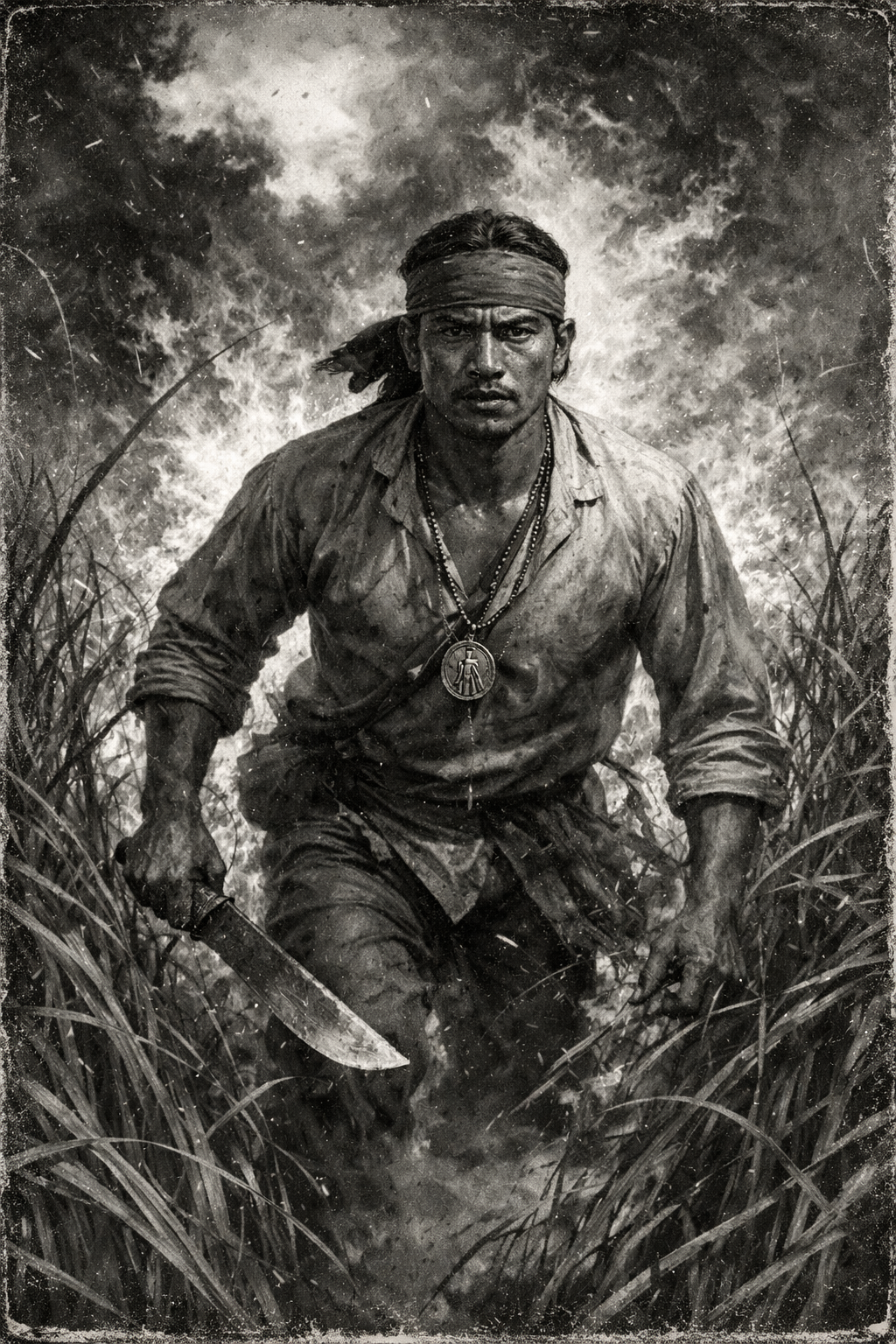
My father would lower his voice when he narrated it. Pedro was cornered in a talahiban in Masbate during the dry season. The grasses were brittle. The wind carried heat. The Spaniards surrounded him. He was one of those that made them cringe. Someone they hated most but couldn’t catch. So when they surrounded him in that grassy field, they set the grass on fire.
The flames rose. The smoke thickened. The soldiers waited for the crackle of surrender. But when the fire died, Pedro was gone.
“He had a San Benito medallion,” Papa would say. “An anting-anting. That’s why he survived.”
As a child, I believed it without question. Heroes in our stories were protected — not by armor, but by faith. But I have been suspecting that my father had embroidered the tale. Maybe Lola had told him something similar. Maybe the details grew sharper over the years, like grass drying under the sun.
And then I came across a name in a historical study.
Pedro Quipte.
He was not a national hero with marble statues. He did not draft constitutions or write novels. He emerged instead from the countryside of Masbate in 1898, a leader of the Pulahanes — a peasant movement clothed in red and conviction.
The Pulahanes were rural men of faith. They believed in divine protection. They wore red garments symbolizing sacrifice. They carried amulets and anting-anting into battle. To colonial authorities, they were fanatics. To their communities, they were defenders.
In June 1898, Quipte and his men reportedly ambushed Spanish forces in the barrios. On August 19 of that year, Pulahan fighters attacked and burned the capital of Masbate. Spanish officials fled.
For a brief, combustible moment, colonial authority collapsed.
The fire in my father’s story may not have been metaphorical after all.
History, however, is less forgiving than folklore.
After the Americans arrived around 1900, the Pulahanes were suppressed. Leaders like Quipte faded from official records. He reportedly withdrew to a sitio in Camayabsan and died of illness in the early years of the new century.
No confirmed birth year.
No recorded death date.
No portrait.
Only fragments.
And perhaps that is why the burning grass survives in memory.
Because when the archives fail, stories fill the space.
Was there truly a field set ablaze? Was there a San Benito medallion that turned aside flame? Scholars cannot confirm it. But they do confirm that Pulahan fighters believed in spiritual armor. They marched into gunfire convinced that faith made them untouchable.
In that sense, the legend is not false. It is faithful.
As an adult, I no longer imagine a man walking unscathed through fire. I imagine something subtler: a leader slipping through smoke while soldiers assume victory too quickly. A man protected less by magic than by courage and the chaos of battle.
And yet, when the dry season comes and the grass turns brittle under the sun, I think of the image my father planted in my mind — Spaniards waiting in the smoke, certain they had won.
They did not understand that some revolutions cannot be burned away.
Pedro Quipte may not have survived the century in textbooks. But he survived in stories — told in low voices before sleep, where history and myth meet, and where a child first learns that freedom is often born in fire.




Leave a comment