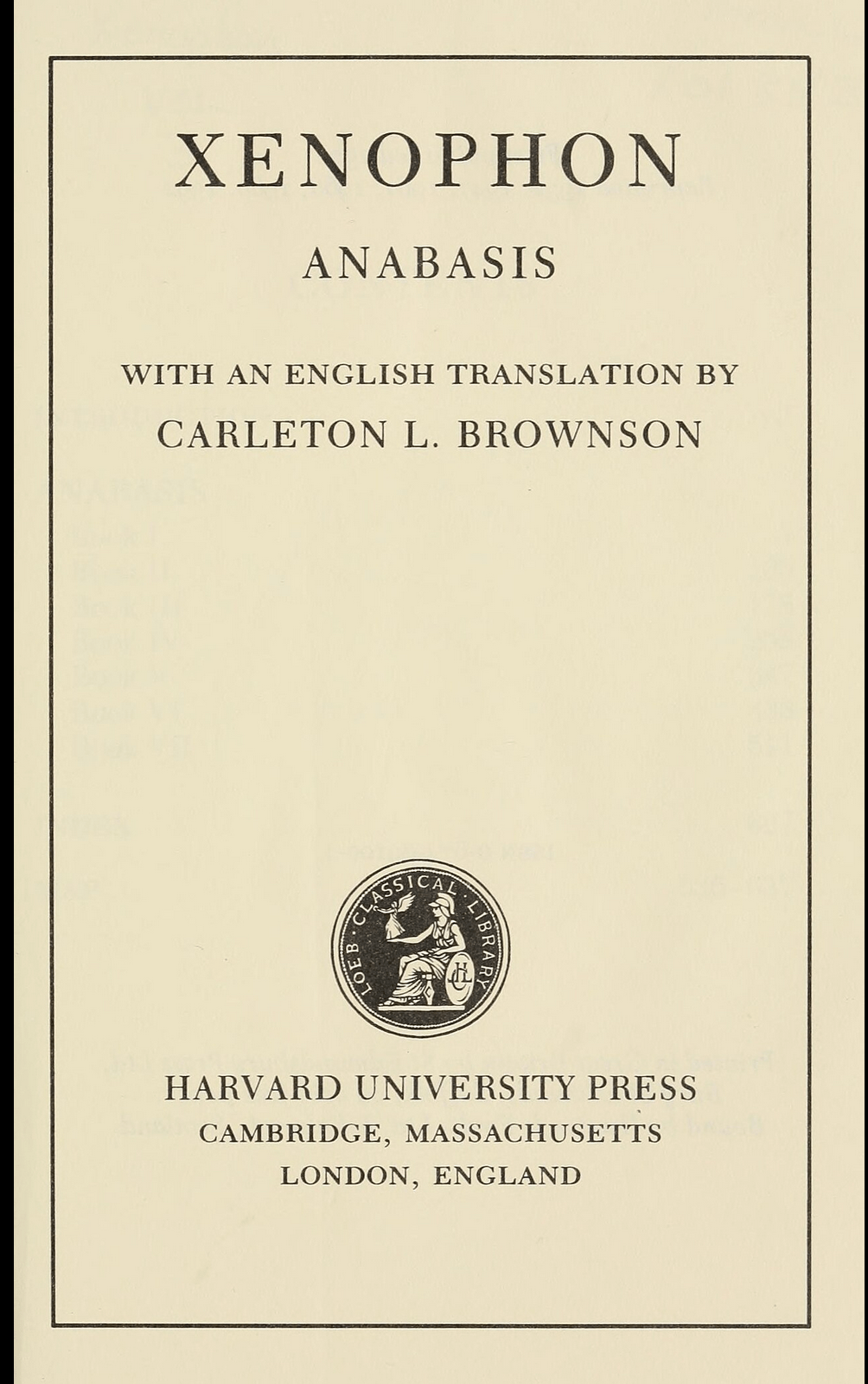
Iran, formerly called “Persia”, has been a center not only of civilization but also a theater of conflict. With Donald Trump attacking Iran, my interest on understanding the latter was triggered so I looked for books and articles that could explain why Iran has been attracting too much attention. One of the historical ones that I found is Anabasis, a story written by Xenophon — a Greek mercenary who joined Cyrus the Younger in the struggle for power against King Artaxerxes II.
The story is interesting because the story of retreat of the 10,000 Greek mercenaries recruited by Cyrus is quite applicable today. Even the book itself is a must-read not only in military schools but also in business and management courses.
The full review is published in the Galing Pook page.
Local Leadership in a Global Crisis: An Anabasis for Philippine LGUs
Iran has always been a theater of conflict. In the 4th century BCE when it was still called “Persia”, Cyrus the Younger recruited at least 10,000 Greek mercenaries with a straightforward mission: march into Persian territory, win a political struggle against King Artaxerxes II, claim victory, and return home rewarded. But the plan failed and Cyrus was killed in battle. The Ten Thousand was then left stranded deep in hostile territory—leaderless, surrounded by enemies, and far from home.
The Greeks retreated and this story was documented by Xenophon, one of the Greek mercenaries who responded to Cyrus’s call, in a book titled “Anabasis”.
From Ancient Marches to Modern Oil Wars
The modern-day Persia is again at the crossroads of war and power with the world as its battlefield. The escalating tensions and confrontations between the United States and Iran have threatened key oil routes disrupting global supply chains and driven fresh volatility in global energy markets. For a country like the Philippines which is heavily dependent on imported fuel, the effects are immediate and far-reaching. Rising global oil prices quickly translate into higher domestic fuel costs, increased transportation expenses, and upward pressure on the prices of basic goods. The strain has been felt on the ground, including renewed calls for relief measures and transport-sector action. And, just like the Greeks in Anabasis, we find ourselves navigating a situation we did not initiate, in a terrain we do not control.
The Greek mercenaries did not expect to retreat. Similarly, Filipino families did not expect sudden, repeated increases in fuel prices. Yet both situations share a common turning point — The original plan no longer works.
Budgets are then recalibrated, travel is reduced, and livelihoods are strained. The shift is subtle but profound: From planning to coping, and from growth to survival.
The Cost of Leadership Gaps
In Anabasis, survival became possible only when leadership stabilized. Xenophon helped provide direction, purpose, and communication.
In contrast, leadership uncertainty today—marked by public disagreements and mixed policy signals—creates confusion. In times of crisis, uncertainty at the top cascades downward, leaving ordinary citizens to bear the heaviest burden.
LGUs as the modern-day Xenophons
If there is a level of governance that can respond with immediacy and clarity, it is the Local Government Units (LGUs). LGUs operate closest to the lived realities of citizens including the transport operators and drivers struggling with fuel costs, market vendors adjusting prices daily, commuters trying to manage their daily budgets, and families stretching their limited incomes.
In this context, LGUs are not merely implementers of national policy. They are frontline institutions of stability and response. They can provide targeted assistance to vulnerable sectors, strengthen price monitoring and local market regulation, support localized production systems to reduce dependency on long supply chains, and promote alternative and more sustainable transport solutions, among others.




Leave a comment