Bicol’s latest poverty numbers bring a message that is both hopeful and troubling. Region V improved in 2023. But the recovery was uneven, fragile, and far from enough.
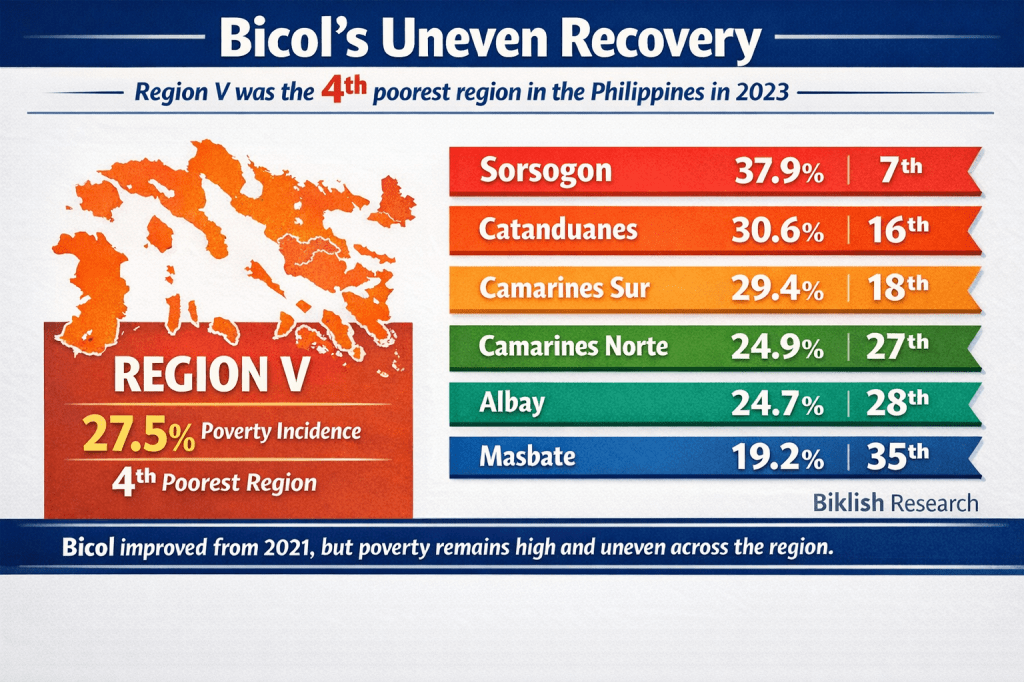
According to the latest Philippine Statistics Authority (PSA) full-year poverty statistics, Bicol Region posted a poverty incidence among population of 27.5% in 2023, down from 29.3% in 2021.
That sounds like progress. But compare it with 27.0% in 2018, and the picture changes. Bicol has improved from the pandemic years, but it has not fully regained where it once was.
Nationally, that 27.5% puts Region V as the 4th poorest region in the Philippines in 2023, behind only BARMM, Zamboanga Peninsula, and the Negros Island Region. So this is not just a regional concern. Bicol remains one of the country’s most poverty-burdened regions.
That is the big picture. But the more revealing story is inside the region itself.
One region, very different realities
The first thing the data shows is that there is no single Bicol poverty story. While some provinces improved, others barely moved. Some clearly worsened.
The most alarming case is Sorsogon. In 2023, it posted a poverty incidence among population of 37.9%, the highest in Region V. More strikingly, when placed against the rest of the country, Sorsogon ranked 7th highest among Philippine provinces in poverty incidence, using province-only comparisons.
That is not just bad by Bicol standards. That is severe by national standards.
Its trend is even more troubling. Sorsogon was at 26.1% in 2018, rose to 30.0% in 2021, and then jumped to 37.9% in 2023. That is not a slow recovery. That is a strong reversal.
Catanduanes also landed in the national high-poverty tier. With 30.6% poverty incidence, it ranked 16th highest among provinces nationwide.
Camarines Sur, at 29.4%, ranked 18th nationally, effectively placing it in the country’s top 20 poorest provinces.
That means three Bicol provinces—Sorsogon, Catanduanes, and Camarines Sur—were all in the national top 20.
That alone should be enough to remind policymakers that Bicol’s poverty challenge is not marginal. It is one of the country’s major development problems.
Masbate is the surprise, CamSur the burden
The most surprising provincial story in Region V is Masbate.
For years, Masbate was often associated with chronic poverty. But in 2023, it posted the lowest poverty incidence in Bicol at 19.2%. Nationally, that placed it at 35th highest among provinces—still poor, yes, but notably better than the rest of Region V.
In other words, the province many would have casually assumed to be among Bicol’s worst performers actually came out as its best-performing province in the latest data.
Meanwhile, Albay posted 24.7%, placing 28th nationally, while Camarines Norte, at 24.9%, ranked 27th.
But if Masbate is the surprise, Camarines Sur is the burden.
Though not the worst in percentage terms, CamSur remained the province with the largest number of poor people in Region V. In 2023, it had around 621,120 poor persons, the biggest poverty headcount in the region. That was followed by Albay with 354,310, Sorsogon with 330,420, Masbate with 184,640, Camarines Norte with 159,720, and Catanduanes with 85,470.
So poverty in Bicol has two faces. One is the depth of deprivation, seen in places like Sorsogon. The other is the scale of deprivation, seen most clearly in Camarines Sur.
The cost of simply not being poor has gone up
The burden becomes even heavier when we consider how much more expensive life has become.
In Region V, the annual per capita poverty threshold rose from ₱24,461.02 in 2018 to ₱27,675.26 in 2021, then climbed sharply to ₱33,574.72 in 2023.
That means families needed much more money in 2023 just to avoid being classified as poor.
So even where poverty incidence improved on paper, ordinary life did not necessarily become easier. The statistics may show recovery, but many households likely still felt squeezed by rising food prices, transport costs, and the general cost of living.
That is why the phrase “uneven recovery” fits Bicol so well. The region may be moving forward overall, but many families are still running uphill.
The municipal picture is even harsher
Regional and provincial averages can hide the real severity of local poverty.
In Camarines Sur, Garchitorena posted a poverty incidence of 44.05% in 2023. Balatan was at 37.63%, Presentacion at 36.59%, and Tinambac at 36.09%.
In Sorsogon, the burden was spread across multiple municipalities: Santa Magdalena reached 40.52%, Matnog 40.25%, Pilar 39.45%, Juban 39.36%, Donsol 39.18%, and Magallanes 38.59%.
In Catanduanes, Caramoran hit 41.43%, while Viga and Pandan were both above 34%.
In Albay, Rapu-Rapu stood at 39.92%, with Jovellar, Libon, and Pio Duran also staying in the high-poverty range.
These are not minor deviations from the regional average. These are places where roughly four out of every ten residents are poor.
That is why a regional figure like 27.5% can sometimes understate the pain on the ground. The average may describe Bicol as a whole, but it cannot fully capture the intensity of poverty in the hardest-hit towns.
Urban centers still have the advantage
On the other side of the map, the better-performing localities were mostly urban centers and service hubs.
Naga City posted 10.27%, one of the lowest in Region V.
Daet came in at 12.78%.
Masbate City posted 13.42%.
Virac was at 14.52%.
Legazpi City came in at 16.32%, with Daraga at 16.94%.
The pattern is not difficult to read. Areas with stronger commerce, more government presence, better connectivity, and larger service economies tend to perform better. Remote, island, upland, and coastal municipalities tend to struggle more.
This means Bicol’s poverty problem is not just about low incomes. It is also about distance, isolation, uneven infrastructure, weak market access, and unequal opportunity.
The real meaning of Bicol’s uneven recovery
The 2023 poverty figures do not tell a story of total failure. But they do not support a victory narrative either.
Yes, Bicol improved from 2021. But it remained the 4th poorest region in the country.
Yes, some provinces improved. But Sorsogon became one of the poorest provinces nationwide.
Yes, Masbate surprised on the upside. But Camarines Sur still carried the largest number of poor people in the region.
Yes, the region moved forward. But many municipalities are still trapped in extremely high poverty.
That is the real meaning of Bicol’s uneven recovery.
The region is not standing still. But neither is it rising together.
And until the gains reach the towns and provinces that continue to lag behind, Bicol’s recovery will remain incomplete—visible in the averages, perhaps, but not yet fully felt in everyday life.





Leave a comment