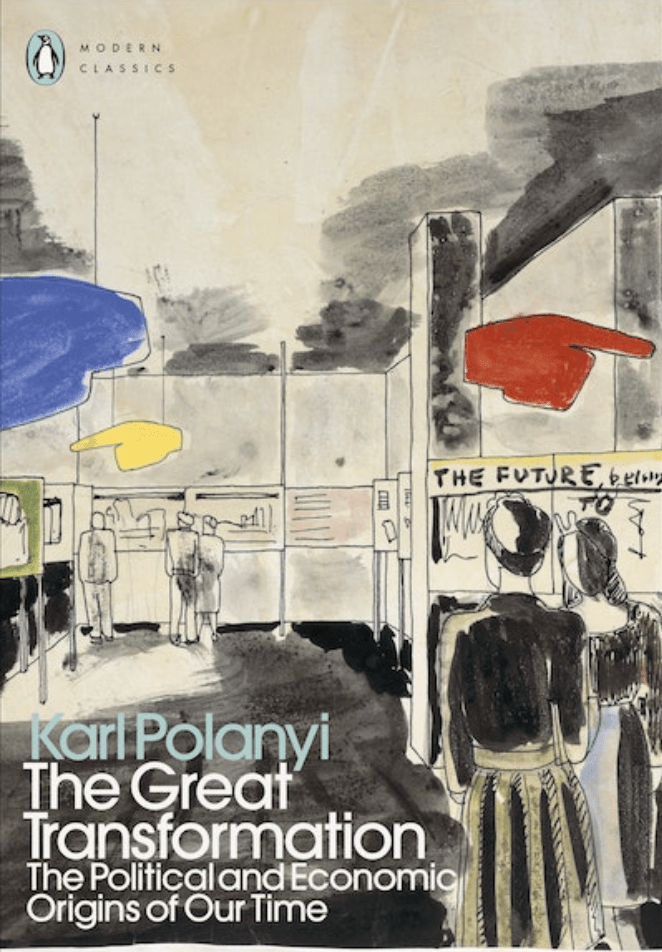
While reviewing a course on Political Economy for a talk on local economic development, I came across Karl Polanyi’s The Great Transformation: The Political and Economic Origins of Our Time. It was one of the highly reprinted classic in political economy.
Karl Polanyi’s The Great Transformation remains one of the most powerful books for understanding why development conflicts are never just about economics. First published in 1944, the book argues that the rise of the modern market economy was not a natural or neutral process. It was a political and institutional project that tried to reorganize society around the market, rather than keeping markets embedded within social life. Polanyi’s broader concern was that when economic relations are detached from social obligations and community protections, society pushes back. He saw this tension as central to the crises of modern capitalism.
That argument makes The Great Transformation especially useful for reading “Development, Disputes and the Politics of Bicol’s Shorelines.” In the shoreline piece, we argue that Bicol’s coasts are no longer just geographic edges or livelihood spaces. They have become contested political spaces shaped by questions of power: who decides, who benefits, and who keeps access when coastal land shifts from shared use to strategic asset. It describes a transition from customary access and livelihood-based use toward investment, documentation, reclassification, enforcement, and dispute.
This is precisely where Polanyi becomes illuminating.
One of Polanyi’s most important insights is that land should not be treated as if it were an ordinary commodity. In his framework, land, labor, and money are “fictitious commodities” because they are not originally produced for sale in markets, yet market society tries to treat them as if they were. The result is instability and social disruption, because what is being bought and sold is not just an economic input but part of the very fabric of life. Britannica notes that Polanyi’s work examined how the expansion of capitalism attempted to create a market society, while other summaries of his work emphasize his argument that society eventually resists when market rule becomes too socially destructive.
Seen through that lens, the Bicol shoreline is not just real estate. It is livelihood space, cultural space, ecological space, and social space. Note that for generations coastal communities are strongly related to the shoreline primarily through use — fishing boats launched from familiar landing points, access was customary rather than contractual, and what mattered was continuity of livelihood rather than the mere existence of title. The coast functioned as shared space before it increasingly became a site of investment and legal contestation.

That shift is the heart of the review. Polanyi helps explain why the conflict feels so deep. The tension is not simply between legal owners and informal users, or between development and resistance. It is between two different ways of understanding the coast. One sees it as a community-embedded space governed by habit, livelihood, and social ties. The other sees it as an asset to be classified, valued, improved, fenced, protected, reclaimed, or redeveloped. Does the Siruma tensions ring a bell? As coastal areas are viewed as a commodity improved roads, tourism promotion, port expansion, coastal protection projects, and waterfront beautification will definitely increased shoreline land values and intensified legal scrutiny.
Another major Polanyian idea relevant here is the “double movement.” On one side is the push to expand market relations and commodify more aspects of life. On the other side is the countermovement by society to defend itself through law, regulation, political action, and social claims. Polanyi saw this as a recurring pattern in capitalist development.
Out pice on Bicol’s shorelines is simply a local example of that double movement. The expansion side includes coastal roads, boulevards, ports, reclamation, tourism strategies, and rising investor interest. The protective side includes claims about public access, shoreline easements, environmental regulation, classification doctrines, and local resistance when landing sites, footpaths, and fishing grounds are threatened. The legal cases decided by the Supreme, the fencing controversies, reclamation disputes, fisherfolk concerns, and conflicts over foreshore classification all show that what is happening is not merely physical development. It is a struggle over how society will defend access, ecology, and livelihood while market pressures intensify.
What makes The Great Transformation so valuable here is that it prevents us from using the lazy language of “anti-development” versus “pro-development.” Polanyi would likely tell us that the real issue is not whether development happens, but whether the rules of development subordinate society to the market or discipline the market in the interest of society. As we earlier noted, development is neither inherently harmful nor inherently benign; the key political questions are about process, participation, distribution, and access. And Polanyi best explains the underlying drama of the shoreline itself: the conversion of a socially embedded, livelihood-centered space into a legally contested and economically valorized frontier.
As a book, The Great Transformation is not always easy reading. It is dense, historical, and at times sweeping. But its core message remains sharp: Markets are made by institutions, and when societies are reorganized to serve markets rather than the other way around, conflict is inevitable.
For Bicol, that lesson is highly relevant. The shoreline is not just where land meets sea. It is where competing ideas of development meet each other. Polanyi helps us see that the real question is not only who owns the coast, but what kind of social order the coast will reflect. Will it remain a shared space of livelihood, identity, and access? Or will it become a segmented asset class governed mainly by valuation, paperwork, and exclusion?
That is why The Great Transformation is not just a classic text in political economy. It is also a useful guide for understanding the politics of Bicol’s shorelines today





Leave a comment