
Roads do not merely connect places; they connect opportunities. In development economics, this is often explained through “market access” — the idea that when transport costs fall and connectivity improves, local producers and workers can reach markets more easily, enabling trade, specialization, and productivity gains.1 Evidence from large-scale road programs likewise suggests that improved connectivity can reshape local labor markets — often enabling shifts from low-productivity activities into higher-value non-farm work, depending on context and complementary conditions.2
In Bicol, the road story has two faces.
On the national side, the 2024 roads inventory of the Department of Public Works and Highways (DPWH) shows that Bicol’s national road network is overwhelmingly paved primarily with concrete, followed by those with asphalt. Structurally, the region’s major corridors appear established. The “lukso-rious” parts of the Maharlika Highway, however, is another story. But the point is, of the 2,680.26 kilometers of national roads in the region, 2,641.55 kilometers are paved according to the DPWH.
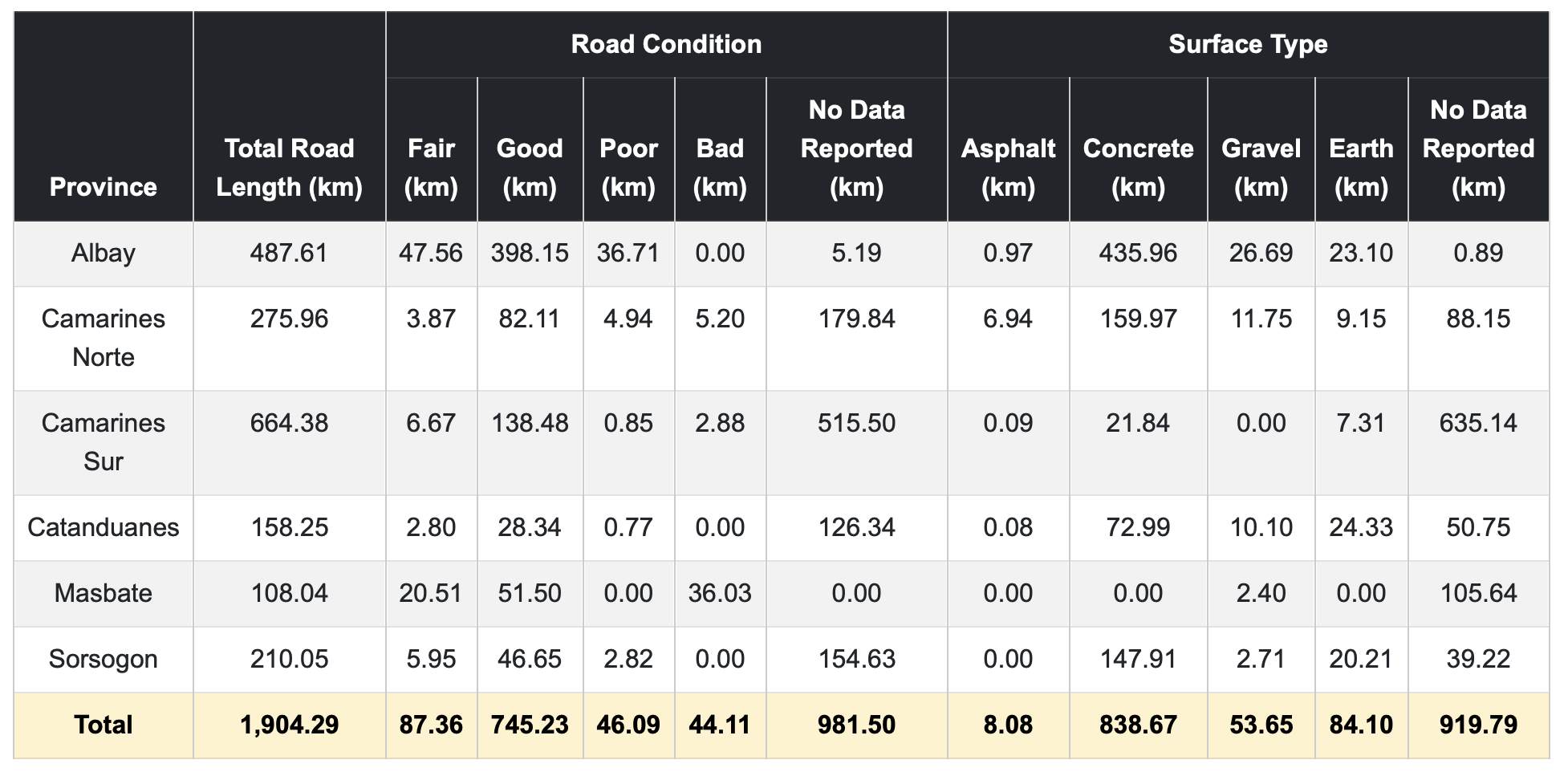
On the local side, the DILG’s Local Roads and Bridges Inventory (LRBI) data of the Department of the Interior and Local Government (DILG) shows a more complex reality across 1,904.29 kilometers of local roads. Some provinces, most notably Albay, present a strong condition profile. Yet the regional pattern is dominated by a single striking category: “No Data.” More than half of Bicol’s local road network is recorded as “No Data Reported” for condition, and almost half is “No Data” for surface type.
In infrastructure governance, “No Data” is not a neutral category. It signals weak visibility — that is, the inability of planners and decision-makers to confidently identify what needs to be maintained, rehabilitated, or protected before deterioration becomes expensive and widespread.
Provincial Comparisons: Uneven Conditions, Uneven Visibility
Albay presents one of the clearest local-road profiles in the region. Of the 487.61 kilometers of road, 398.15 kilometers are “Good”, 47.56 kilometers are “Fair”, 36.71 kilometers are “Poor”, and only 5.19 kilometers fall under “No Data” for condition. This combination—relatively strong condition results plus credible reporting—matters because what is measured can be managed and funded more strategically.
Masbate, by contrast, shows a substantial “Bad” segment: 36.03 kilometers out of 108.04kilometers. This is the kind of profile that often translates into higher transport costs, weaker market participation, and reduced service access—especially for rural communities.
The provinces of Camarines Sur, Camarines Norte, Catanduanes, Sorsogon share the region’s most consequential governance signal: high “No Data” for condition. When the majority of roads are unclassified, planning becomes reactive. The province ends up fixing what is visible, not necessarily what is most economically important.
This matters because the poverty and welfare impacts of rural roads documented in the literature — through reduced transport costs and improved market outcomes — require intentional prioritization, not guesswork.3 In practical terms, a province cannot credibly align infrastructure programs with development goals if a large share of its road network remains unmapped in terms of condition.
Roads, Poverty, and Local Economic Development
The research literature generally supports three claims relevant to Bicol:
- Connectivity can change local economic structure.
Large road programs have been shown to influence how local labor markets function, including shifts in occupational patterns and the structure of employment when communities become less isolated.2 - Road investments can reduce poverty and improve welfare.
Studies using household data have found that rural road investments can reduce poverty and improve welfare through improved access and market participation, although magnitudes vary.3 - Impacts are context-dependent and often require complementary conditions.
Evaluations of rural road rehabilitation projects show that roads can improve market development and welfare-related outcomes, but effects differ depending on local geography, complementary services, and the quality of implementation and maintenance.4
For Bicol, the implication is straightforward: roads are an enabling platform. But converting roads into inclusive growth depends not only on building, but on governing — particularly on maintaining the links that unlock economic activity and reduce the everyday transaction costs faced by households and micro-enterprises.
Data Governance as a Core Infrastructure Issue
The most actionable insight from the LRBI table is not merely which province has more “Good” roads. It is that “No Data” dominates the condition profile for several provinces.
That is a data governance problem with real economic consequences:
- Planning failure. Without condition data, prioritization of rehabilitation vs preventive maintenance becomes speculative.
- Budgeting failure. Without baselines, it becomes harder to defend allocations and harder to demonstrate value-for-money.
- Accountability failure. Without measurable starting points, it is difficult to verify improvements.
- Equity failure. Remote and low-income communities are more likely to remain invisible—precisely the communities that may benefit most from improved road access.3
In short: local economic development requires evidence-based spending. Evidence-based spending requires road data that is complete, consistent, and updated.
A Bicol Road Data Governance Compact
If Bicol wants its roads to remain uragon—and stop becoming daily sources of frustration—one practical reform is to institutionalize road data discipline through a regional compact:
- Annual condition updating as a routine governance requirement
- Surface-type completion as a prerequisite for credible costing and maintenance design
- Public road report cards to make performance visible and comparable across provinces
- Citizen validation mechanisms (barangay-level verification, community monitoring) to ensure reports match lived experience
These may appear administrative, but they are foundational. They determine whether road investments are strategic and development-oriented—or reactive, politicized, and expensive.
Uragon Roads Require Uragon Governance
Bicol’s national roads appear structurally mature. The local road network is more mixed—and in several provinces, insufficiently visible.
The international evidence is clear: improved connectivity can reshape local economic outcomes by improving market access and lowering transport costs.1 Road programs have also been shown to influence local labor markets and poverty outcomes under certain conditions.23 But Bicol cannot fully harness these gains if a large share of its local road network remains unclassified.
In infrastructure, what is not measured is not managed.
And what is not managed cannot remain uragon for long.
Footnotes
- Donaldson, D., & Hornbeck, R. (2016). Railroads and American Economic Growth: A “Market Access” Approach.Quarterly Journal of Economics, 131(2), 799–858.
- Asher, S., & Novosad, P. (2020). Rural Roads and Local Economic Development. American Economic Review, 110(3), 797–823.
- Khandker, S. R., Bakht, Z., & Koolwal, G. (2009). The Poverty Impact of Rural Roads: Evidence from Bangladesh.Economic Development and Cultural Change, 57(4), 685–722.
- van de Walle, D. (2009). Impact Evaluation of Rural Road Rehabilitation in Vietnam. World Bank Policy Research Working Paper (and related reports).








Leave a comment